
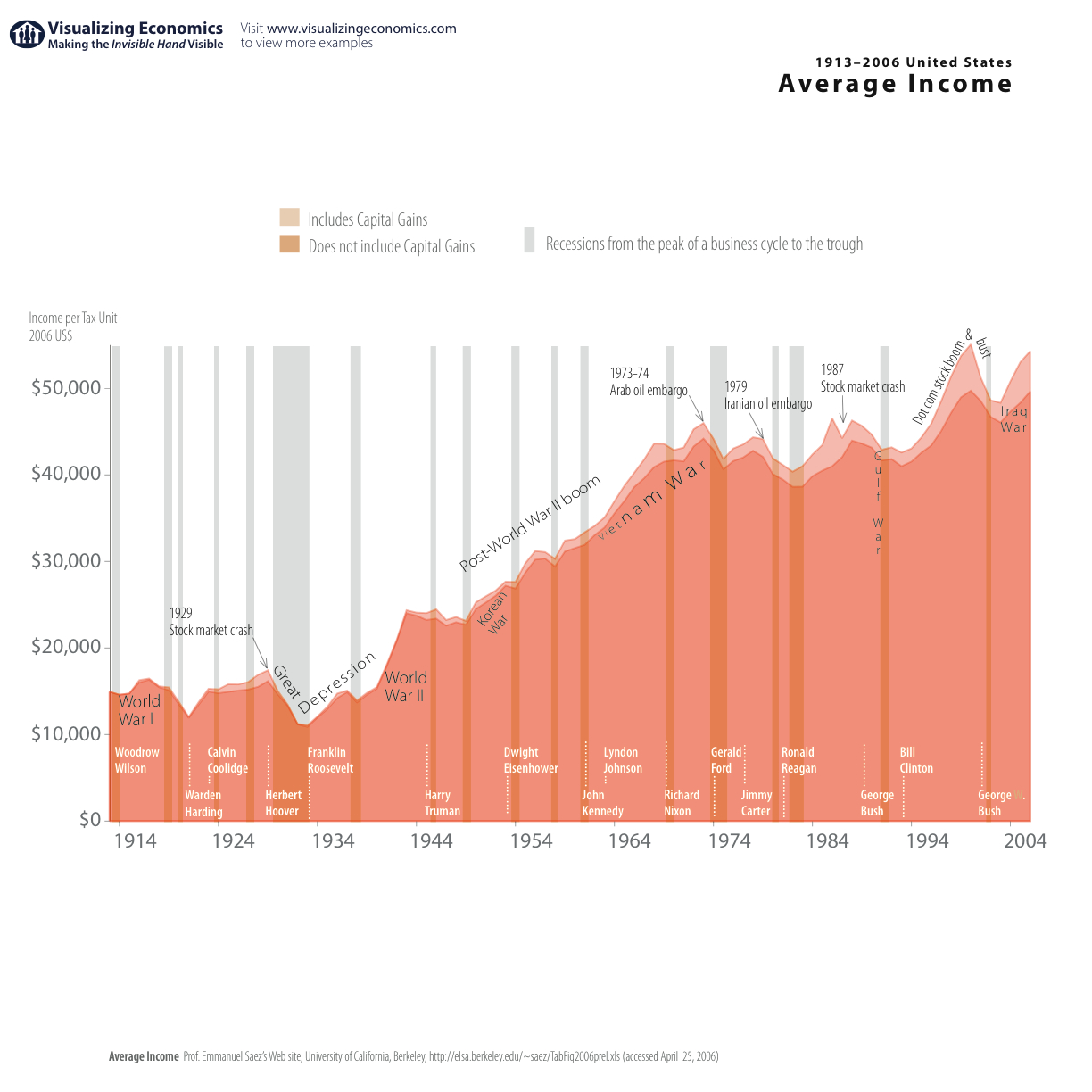
I have updated my most popular graph Average Income in the United States. It now includes data through 2006 (in 2006$). I also added recessions from National Bureau of Economic Research
{Click on the image to take a closer look}
![]()
Data from Emmanuel Saez’s web site
[tags]Average Income, United States, Recessions[/tags]


Visualizing Economics was created by 
{ 7 trackbacks }
{ 23 comments… read them below or add one }
HI thanks,i was looking for this data!
Are you a student?
hey one more question
Is it per annum or monthly?
I guess it to be per annum
Is this adjusted for real inflation? NOT those silly numbers the government releases these days, but the old true inflation measurement?
Relly nice graph BTW, just would love to see it adjusted for real dollars and purchasing power.
This doesn’t look like it’s adjusted for inflation. Is there a source for that graph?
Interesting graph. FWIW, his name was Warren Harding, not Warden.
As other mentioned inflation renders these somewhat useless. Rather than being relative to USD I’d like to see the data relative to fixed commodities (gold/oil/rice/?) — since last I checked you can’t print them too easily.
Would be nice to see the same graph of median income adjusted for real dollars and purchasing power. Average income means nothing. Me and Warren Buffet had an average taxable income of 23 Million in 2006.
You sure about the average income in 1913. My great grandfather made about
100-125 a week in that era and was considered above average income. And
he was in northern New Jersey.
John – it’s adjusted for inflation. Most people don’t seem to be noticing that it says 2006 dollars there on the left.
See this pops the bubble in the conspiracy theorists heads. People need to open up a history book. Life sucked for average people in the old days.
The Inflation Calculator
“What cost $125 in 1913 would cost $2653.76 in 2007.
Also, if you were to buy exactly the same products in 2007 and 1913,
they would cost you $125 and $6.05 respectively.”
http://www.westegg.com/inflation/infl.cgi
Agree with you Ms Siegel. However, this is a stated chart of average
national income. While my ggf enjoyed an above average annual salary
around $5000, by the inflation calculator he had the purchasing power
of $125,000 a year. Now the above chart places average national income
around 13-15,000 a year figuring in areas such as the south and midwest
which were still very agrarian. Figure seems very high for a national
compared to a regional outlook.
Dear John, Someone who made $100 to $125 a week in 1913 was quite wealthy. In the day of the $500 car, that would have been enough to buy a new Ford every month. Buying a new Ford every month today would cost about $200,000 a year. Are you sure it wasn’t $100 to $125 a month? That would have been more typical.
Also, I am pretty sure the graph is in constant dollars. When I got out of college in 1967, starting pay for a college graduate was around $5000 a year. The graph shows around $40,000 a year in 1967.
It is disturbing to me, having been Googling for “average household income” that median incomes are routinely presented as averages. It seems to me that income data would be heavily skewed towards the low end of the scale …a Poisson Distribution. This suggests that the average income would be much lower than the median income. I think the use of median incomes misrepresents incomes as being comfortingly high.
I agree with several commenters, that the information in the otherwise excellent graph would be more useful if presented a) as a function of purchasing power and, separately, b) in constant dollars.
jacob owns this page sarah and hanah are dummies
I don’t know how these figures have been adjusted, but they do not reflect anywhere close to the actual incomes at the time. I was born in 1939. My family was an “average” family as I grew up and their annual income was under $3000 in the 50’s for sure. In 1962 I graduated from college with an engineering degree and earned a salary of $7000 a year which was above average.
Is there a chart that shows median US income over time, but in raw terms, and inflation adjusted? This chart as presented does not reflect reality for me.
This graph has been adjusted for inflation and does look to be a mean distribution. Using any of mean, median, or mode and calling it an average is considered acceptable in statistics. The use of a mode wouldn’t be the best for data like this. The use of a median will slightly misrepresent the population as a whole since you cannot get back to GDP with it. And the use of a mean will accurately represent the population as a whole yet will be higher than your perceived expectations due to outliers.
If this graph used nominal prices it would be more of a display of inflation rate, rather than one of economic growth which requires the usage of real (real means corrected for inflation) values. Here’s a graph showing the difference.
http://upload.wikimedia.org/wikipedia/en/f/f4/Historic_gasoline_prices.png
Pat, the numbers from the graph correspond very well to the numbers you gave. Using the inflation calculator already provided by another in the comments,
“What cost $3000 in 1954 would cost $21016.46 in 2004.”
I chose ‘54 because it’s an easy line to use and 2004 because it’s the last on the graph. The graph average from ‘54 appears to be $27k-28k.
“What cost $7000 in 1963 would cost $43079.77 in 2004.”
The graph average from ‘63 looks to be $32k-33k. And you already stated you were making an above average pay. I would say you were doing extremely well right out of college and not just “above average”.
I’m also questioning the average income. I just cleaned out my grandparents house and found old tax returns. Grandfather was an engineer and my grnadmother was a teacher. Their income combined wasn’t $13k. How did you come up with that number. Are you sure it wasn’t $1300/year?
This data is just plain wrong. Given that 95% of the population didn’t pay income tax in 1917 and that people earning below $2000 paid 2% income tax and most Americans supported families on <1000 per year these figures are off by a factor of 5-10 between 1913-1930. Not sure where this data came from but it is totally inaccurate.
Mean, median and mode are not all acceptable as fulfilling the term “average” as Will
Nov 9th, 2008 at 3:31 am suggests. There are many measures of the central tendency of populations and each gives a different picture of the population. In the case of income distribution, the arithmetic mean (the most commonly understood average) is handy since population size X arithmetic mean = total income. The median can’t be used this way, always gives a smaller number, but can be used to state the figure which 50% of the population exceeds. Say a room of 1000 people were polled and the results showed median $30,000 and average $50,000. Now add one hedge fund manager that took home $2 billion. The median adjusts up to the next higher take home level–maybe $30,100 or so; the average to almost $2,048,000. With the highest earner present the average no longer clearly represents the income situation of the population.
My assumption is that these figures are annual income not adjusted for inflation and are mean figures. Unfortunately, be they mean (arithmetic average) or median values, they still do not tell the story. By 1932 25% or so were ‘unemployed”, working for nickles and dimes where they could; the CCC started in July 1933 with 225,000 working for a $30 a month–$360 a year; that makes a 225,000 long string of $360 incomes working up the list toward the median. Stories are rife of individuals working for a couple weeks at 20¢ an hour–maybe $2.80 a day–for a few weeks, then spending weeks looking for another job. I’d be surprised if the lower 50% of the workers earned more than $2,000 a year, which adjusts to $37,600 in 2007 dollars. To get a true picture, median income and arithmetic average WITH standard deviation are needed.
These figures do not seem to agree with Wikipedia entry under average income in the US (googled).
Thanks for the enlightening info. Eye opener.
I look at these figures and I while it would be usefull to see both mean and median information, it seems that most of the posts that are trying to contradict the data cite examples that actually support the data. In reference to Greg’s comments about 1933 it appears that the graph shows about $12,000 in 2006 dollars that would translate into an actual average annual income of about $840 in 1933 dollars. This seems in line with the extremely difficult situation so many people found themselves in those years. After all #12,000 average is about 1/4 of todays average; meaning the average household (whether mean or median) had 75% less purchasing power.