
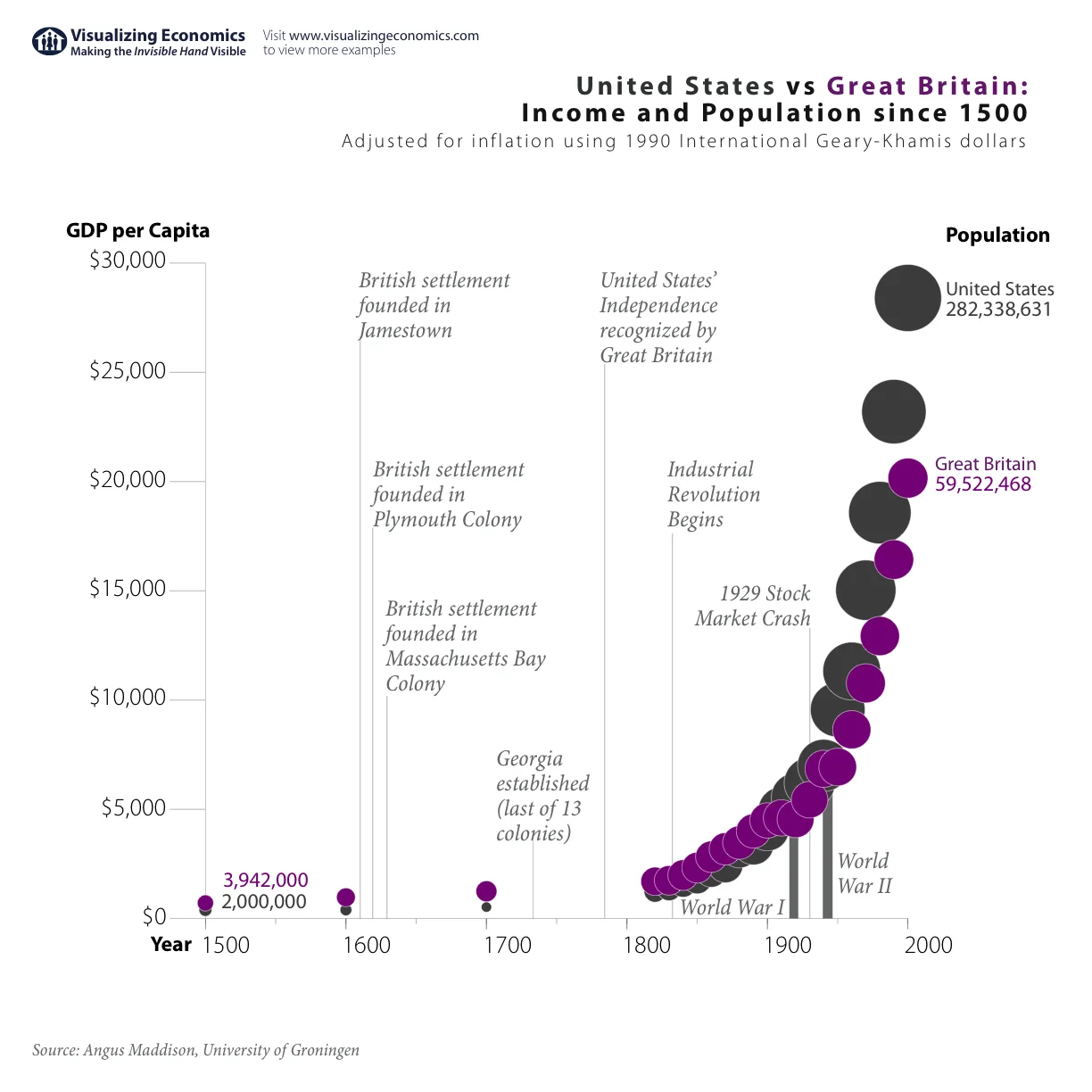
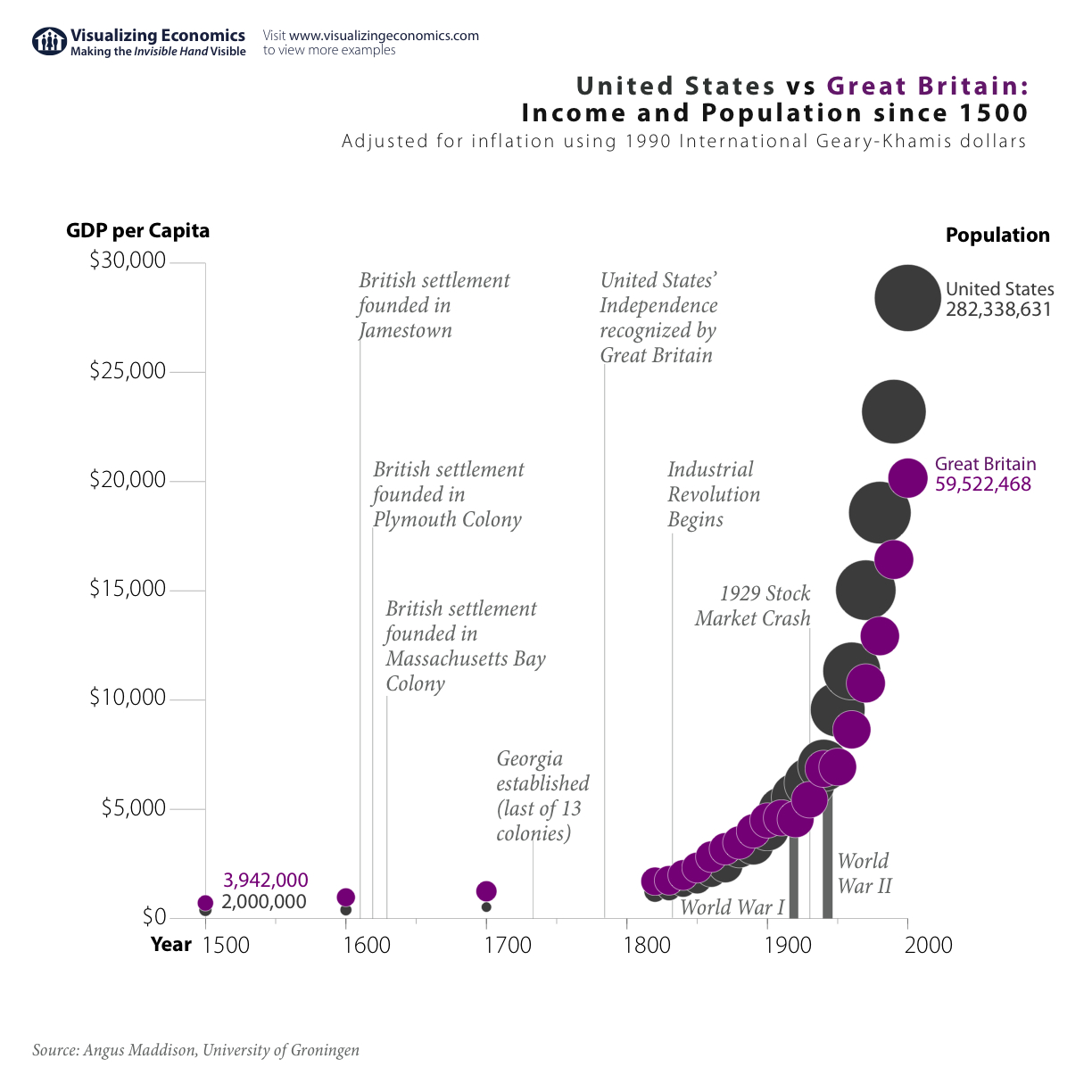
I am revisiting my previous graph United States vs Great Britain: Income and Population since 1500. In my original graph, I placed population on the y-axis which emphasizes its dramatic growth in the US. In the new graph, I placed GDP per Capita on the y-axis which emphasizes the growth in income in both countries. Take a look below at both versions and let me know which you prefer:
New Version: GDP per Capita on the y-axis {Click on the image to take a closer look}
![]()
Original Version: Population on the y-axis {Click on the image to take a closer look}
![]()
See also:
United States: 500 Years of Income and Population Growth
Comparing Population Growth: China, India, Africa, Latin America, Western Europe, United States
China: 2,000 Years of Income and Population Growth
Last 2,000 years of growth in world income and population
Data estimates for population from Angus Maddison Emeritus Professor, Faculty of Economics, University of Groningen.
[tags]population, income, United States, United Kingdom, Great Britain[/tags]
Popularity: 8% [?]
Subscribe
Email Updates
Follow me on Twitter
I do think that this is a better comparison. What I’d also like to see is better use of logarithmic axes to identify changes in exponential trends that a linear axis masks. I gathered the original data for the world GDP per capita graph you recently posted and plotted it with a logarithmic y axis. There is a sharp increase in slope evident at the industrial revolution, a feature almost undetectable on the linear axis graph.
Yes, I agree.
I’m curious to know why the Industrial Revolution is defined as beginning in the mid-1800s.
The innovations that triggered the Industrial Revolution were mid-18th century inventions, and the Industrial Revolution followed immediately afterwards; for example the world’s first water-powered cotton mill was constructed in 1771. Though this technology took some time to spread from Britain to America, the Industrial Revolution truly began during the 1770s.
Indeed, it is probably largely due to this relative technological advancement of Britain that the GDP of the UK remained high compared to the US during the 18th century, as we can see in this graph, where it is perhaps to be expected that the new and flourishing American territories, and their single united successor, would have a rapidly growing economy capable of surpassing Old World nations by virtue of vast untapped natural resources.
Put simply, the Industrial Revolution was practically simultaneous with the American revolution for Britain, and its position on the graph can only be argued to mark the integration of industrialisation into America.
I marked the beginning of Industrial Revolution in the early 1800s in an attempt to show when its effects might be felt on the data series n this graph. I had considered placing it earlier but I have no data between 1700 and 1820 for these series.
Regarding use of logarithmic scales, none of the graphs I have posted had a logarithmic y axis. I have deliberately shied away from using them since for a general audience (which is my target) I felt they would be too confusing.
You site is good!!!
Show my links please.
ïîðíî ñàéò âèðóñ
îíëàéí èãðû áåñïëàòíûå ñåêñ
çàðàáîòîê ïîðíî ñàéòû
çàíÿòèå ñåêñîì îíëàéí
ñêðèïò ïîðíî ñàéòà
ñàéò áåñïëàòíîãî ïðîñìîòðà ïîðíî ðîëèêîâ
õàëÿâíûé ïîðíî ñàéò
ïîðíîãðàôèÿ ïðîñìîòð
ïîðíî ñàéò íåâåñòû
I esteemed yours blog,
thanks the author a lot of useful to myself have found..
Хм… Рмне ÑдаетÑÑ, минуÑÑ‹ прилично превоÑходÑÑ‚ плюÑÑ‹.
Спорить можно беÑконечно, поÑтому проÑто хочу поблагодарить автора. СпаÑибо вам!
Даа… :) Ð’Ñ‹ бы знали что про Ð’Ð°Ñ Ð¿Ð¸ÑˆÑƒÑ‚ в других блогах :)
thanks for the graphs they were a big help
I vote logarithm, you can’t see anything in the earlier years.
Даа… ДоÑтаточно Ñпорно, поÑпорил бы Ñ Ð°Ð²Ñ‚Ð¾Ñ€Ð¾Ð¼…