
{Click on the image to take a closer look}
![]()
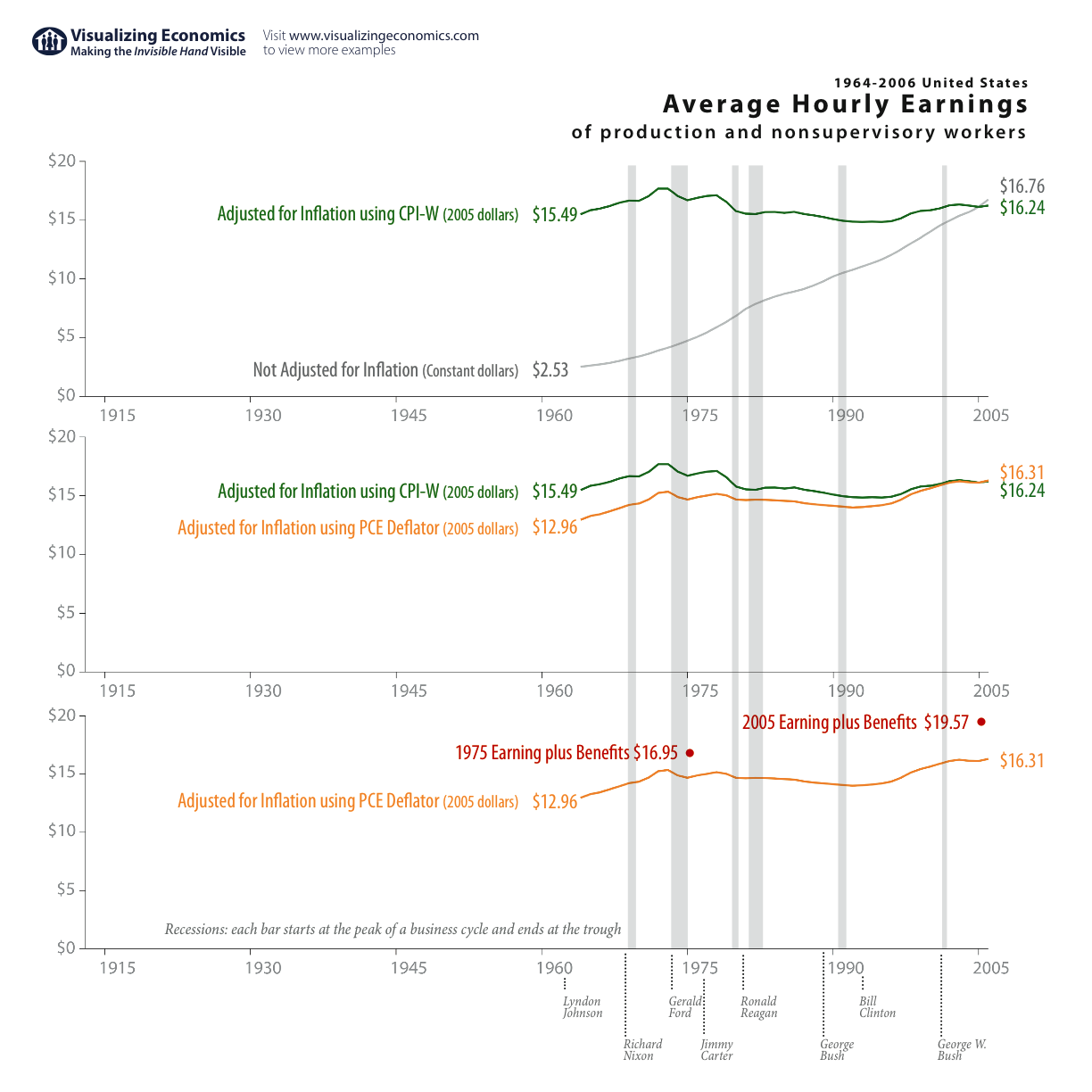
I found a Federal Reserve article that analyzed the change in Average Hourly Earnings for production and nonsupervisory workers. After adjusting for inflation using the Personal consumption expenditures (PCE) {instead of the Consumer Price Index-Urban Wage Earners and Clerical Workers (CPI-W)} and including an estimate for worker’s benefits, the author concluded that workers’ hourly earnings (wages plus benefits) actually increased by 16% over 30 years (1975-2005) rather than decreased. Here, I graphed the full history, 1964-2006, but used the approach laid out in the article to show the effect of inflation and benefits. BTW, if you earned $16.76 an hour in 2006 that gave you an annual income of $33,520 (assuming you worked full-time).
See also:
Average Income in the United States
Total Income of Top, Middle, & Bottom
[tags]income distribution, income inequality, Federal Reserve, wages, middle class[/tags]
Addendum: This was past on to me from a reader who found it on Marginal Revolution
Popularity: 4% [?]
Get the latest graphs and maps sent to you automatically!
Subscribe to my RSS feed or sign up for updates by email.
I’m guessing each of the three graphs represent a group of workers, but what groups? Pretty though.
Oddly, with the exception of the last graph those trends look pretty flat to me. Still, I’ll grant a 16% increase in buying power over the last thirty years. What’s the chart look like for productivity and overall profits? Is that also 16%? Are the people responsible for the alleged explosion in productivity and profit sharing in the fruits of their labor?
The wages are for production and nonsupervisory workers and represents maybe 80 percent of nonfarm wage and salary employees. It is not a perfect measure but it can give some clue as to the trend of wages over time.
I would be interested in seeing the average income in US leaving out the top 5% which seems to me skews the numbers
You should include the period before that if at all possible. I would like to see the effect of Taft-Hartley.