
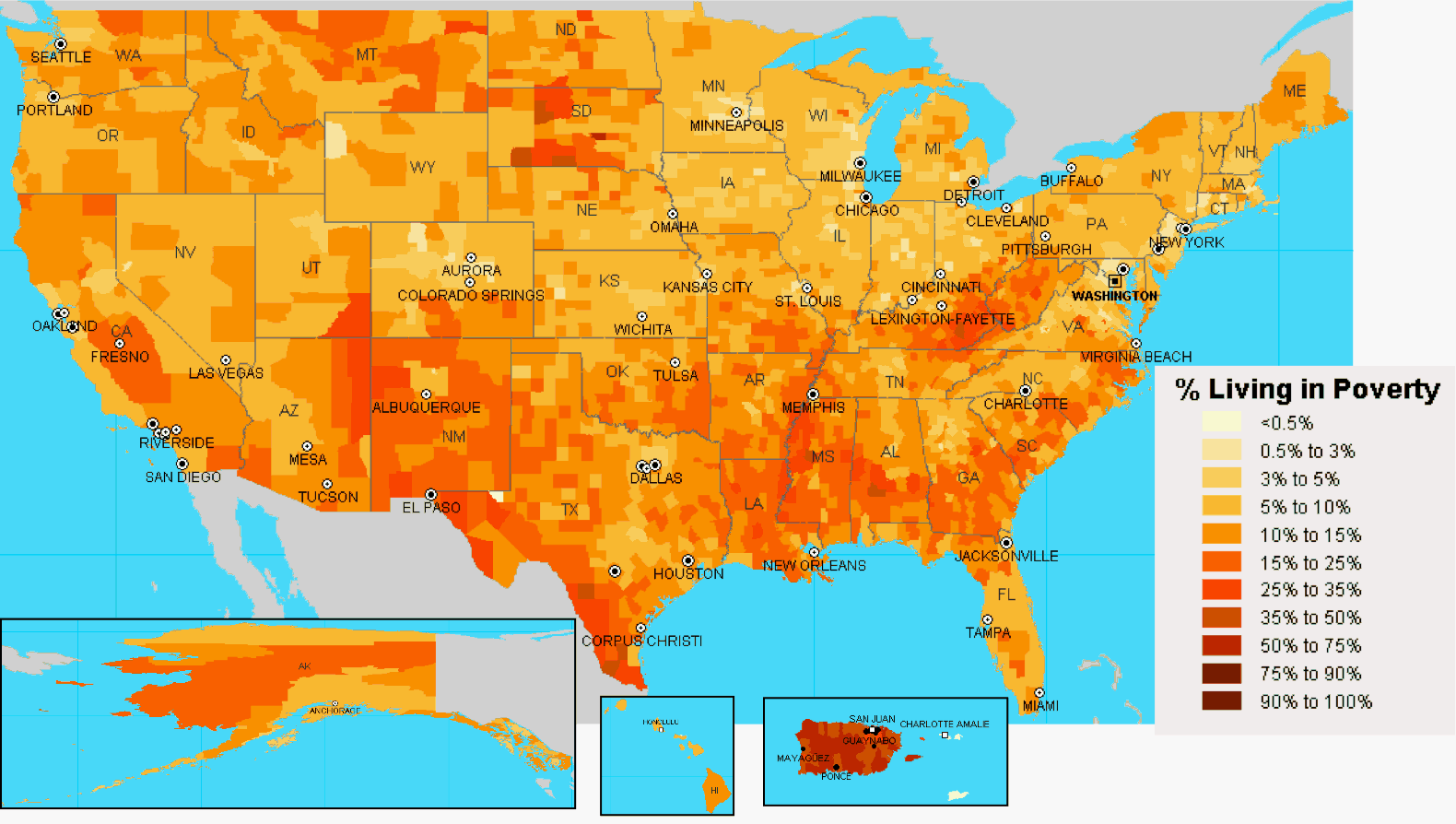
Another income map, this time plotting the % of people living in poverty based on the 2000 Census. If you would like to see a more detailed version go to Social Explorer and choose “Poverty” from the second drop down, then select the magnifying glass to zoom in on a specific county.
{Click on the image to take a closer look}
![]()
See also:
United States Household Income Map
United States Income Inequality Map
Addendum:
8/19/2007 I added Alaska, Hawaii, and Puerto Rico to the map.
[tags]income distribution, US income distribution, inequality, income inequality, income map, poverty[/tags]
Popularity: 43% [?]
Subscribe
Email Updates
Follow me on Twitter
How does US poverty correlate with educational level, IQ, religious belief, ethnicity, skin color, age, health, criminal record and a history of family poverty?
Your definitions of “poverty” and “wealth” against current living standards in the USA appears to be missing from the flowchart.
Alaska & Hawaii are missing from your map of the “United States”….I realize it’s not convenient to plot them, but it’s really frustrating to not see how they compare to the rest of the US. I also agree more information is needed about precisely what is being plotted.
None the less it is interesting to see this information presented graphically.
On firefox for mac, I get a giant X pasted over the bottom half of the image when I click to the large version.
I am using Opera for the mac, and I get the same thing for the larger version.
The worst poverty is on Indian Reservations. The US sure did treat them well.
And once again we see Alaska and Hawaii are not part of the United States. It’s no wonder we get so many tourists visiting directly from the lower 48 carrying their passports around their neck.
Hello There!
This map is deceptive unless it is carefully interpreted. Here are two possible deceptions:
1. It tracks poverty by county–not by city or town or neighborhood. Here is some data: in the “central city” of Houston Texas, 19% of the population lived below the poverty line in 2000 (according to the Bureau of the Census). In the poor areas of Houston, such as the 4th ward, the poverty rate exceeds 50% (according to the Greater Houston Partnership). These high poverty rates are missed by this map; the map shows only the broader area of Harris County, in which Houston is situated. But Harris County also includes rich suburbs with poverty rates below 5%. When one takes the average of the poverty rates of the rich suburbs and combines them with the high poverty rates of the poor central city areas, the resulting average poverty rate makes it look on the map like all is well in Harris County. But of course, poverty is about an extreme–not an average. This map is a demonstration that measures of central tendency such as averages can be quite deceptive; it misses entirely the “slums” and “ghettos” of central cities where poverty is high and persistent.
2. Let me use as an example the county near the middle of South Dakota shaded in dark red, indicating a very high poverty rate. South Dakota is sparsely populated; there may be only a few hundred (or fewer) residents of this county. Even if all of the county’s residents are poor, that is a very small number compared to the many urban residents living in poverty. In Houston, for example, 350,000 people lived in poverty in 2000, according to the census bureau.
Cheers,
Dr. Nigel Cool
In addition to Dr. Cool’s criticisms, I want to point out that this map needs to be shown in an equal-area projection. The current projection or lack thereof distorts the areal size of what is being used to classify the data (counties), and thus misrepresents what it is trying to show.
I just wanted to reply to Mark Borga’s comment that the map is not projected. In fact it is projected and the projection is an Equal Area projection, so it does NOT distort the data.
Dr. Cool, these maps zoom down to census tract level and you can see the poverty in each neighborhood. But you have to actually visit the website to find that out!
U of M
Aug 18th, 2007 at 8:47 am
The worst poverty is on Indian Reservations. The US sure did treat them well.
————————–
Yep. Your tax dollars at work. Way to many people just sit around and live like parasites on the government (federal and tribal). A couple friends of mine grew up on reservations and the apathy of the population is disgusting.
for the key, they put .5%, which is “Less than” .5%.
that wasn’t what i said, they messed it up
What most of you miss is the simple fact: if God Bless America, and America is #1, poverty should be a foreign word that does not exist in USA
Note that the percentage living in poverty is typically higher in red states than in blue states.
This poverty scale is so strict. Our country is one of the wealthiest in the world and we have to have all this poverty. This scale should be used for a world map and we’ll see a lot of countries highlighted heavily in the 90%-100%. Oh, I didn’t think that Puerto Rico was that poor either!